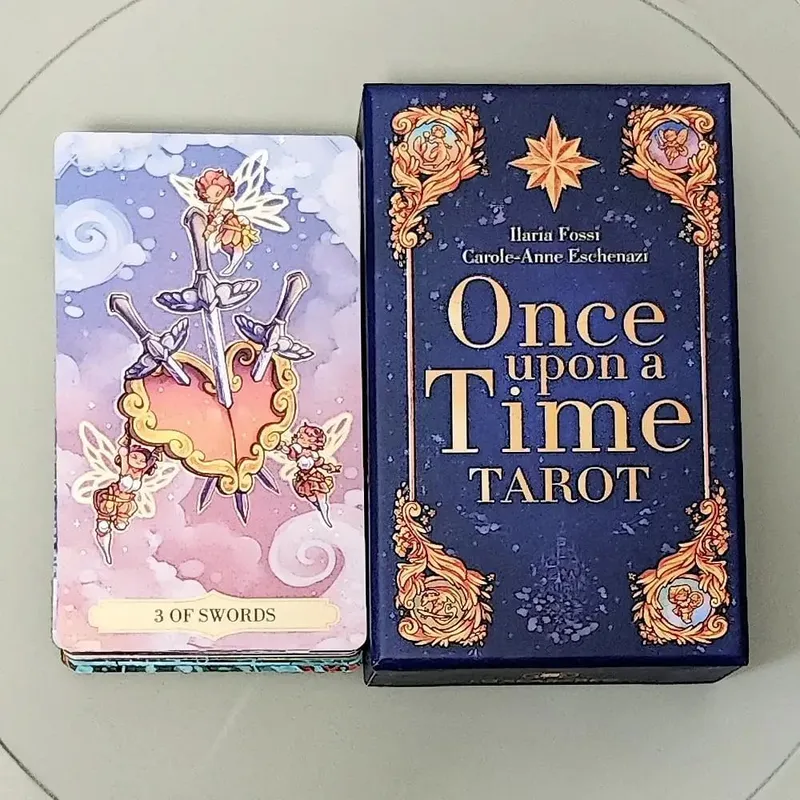
The Once Upon A Time Tarot: A Fairy Tale You Can Actually Hold
I've been selling tarot decks for a long time now, and I'll be honest with you — most of them start to blur together after a while. Another Rider-Waite clone, another moody dark deck, another set of cards that looks gorgeous in photos and then feels like sandpaper in your hands. So when the Once Upon A Time Tarot showed up in my stock room, I figured it would be more of the same. I was wrong. This one stuck with me, and I want to tell you why before it sells out again (it's been moving faster than I expected).
Let's start with what it's actually made of, because this is where a lot of inexpensive decks fall apart — literally. The cards here are printed on proper card stock with a smooth, lightly matte finish. They shuffle well straight out of the box, which isn't always the case; some decks need a week of breaking in before they stop clumping. The corners are rounded cleanly, no rough edges or peeling lamination. Everything comes packed inside a rigid box, and I mean genuinely rigid — not the flimsy tuck box that collapses the second you look at it wrong. This is the kind of box you can keep on a shelf and actually use to store the deck between readings, which matters more than people think. The printing itself is sharp, and the colors hold up nicely under lamplight, which is where most of us do our readings anyway.
Now the exact specifications, because I know some of you want the numbers before anything else. You get 80 cards in total — the standard 78-card tarot structure plus two special bonus cards, which is a nice touch you don't see everywhere. The cards measure 12 by 7 centimeters, so they're a fairly standard tarot size, comfortable for both larger and smaller hands, and easy to riffle shuffle or overhand shuffle depending on your style. The whole thing arrives in that rigid box I mentioned, which keeps everything protected. As for colors and finish variations, that depends on the edition, so check the product page for what's currently available. And if you're the type who likes to keep order numbers handy, this deck is listed under SKU P3256812748311877 — I mention it because folks email me all the time asking which exact version they bought, and that code saves everyone a headache.
So what do you actually do with it? Plenty, honestly. My favorite use case is a slow Sunday morning ritual — coffee, a quiet table, and a three-card spread asking what the week ahead looks like. The fairy tale imagery makes that feel less like a cold calculation and more like reading a story about your own life, which sounds woo-woo until you try it. A close second is journaling. I know several customers who pull one card each evening, write a few lines about how it connects to their day, and that's it — no big ceremony, just a small anchor. And then there's the social side. This deck is genuinely fun at gatherings because the artwork invites conversation. I've watched people who've never touched a tarot deck in their lives lean in and ask about the story behind a card, and that's the whole point, really.
Using it is about as simple or as elaborate as you want it to be. New to tarot? Read the little guide text, do a one-card pull daily for a couple of weeks, and let the images do most of the work. The illustrations are based on well-known fables, so even without memorizing meanings, you'll find yourself making sense of things intuitively, which is honestly how tarot is supposed to feel. If you prefer a structured approach, the Rider-Waite-Smith framework is still underneath everything, so any beginner book you already own will work fine alongside it. As for maintenance — keep it dry, keep it out of direct sunlight for long stretches, and store it back in that rigid box when you're done. If your hands are oily or you've just eaten, give them a wipe first. That's it. No oils, no cleansing rituals required unless you enjoy them. A soft cloth now and then is plenty.
Now for the honest part, because I'd rather you hear it from me than leave a grumpy review. The cons are real but minor. First, if you're a serious collector of borderless, hand-gilded luxury decks, this probably won't scratch that itch — it's a lovely working deck, not a display piece for a glass cabinet. Second, the softer, delicate art style means the linework doesn't jump out the way bold, high-contrast decks do; some readers find it takes a beat longer to read at a glance, especially in dim light. Third, 80 cards means a slightly thicker stack, so if you have small hands and prefer a tight riffle shuffle, you might need to adjust your technique. None of these are dealbreakers at this price. I just don't want anyone buying it expecting something it isn't.
Here's my read on why this design actually works, from someone who's handled a lot of decks. The core idea is pairing the familiar Rider-Waite-Smith structure with fairy tale imagery, and that's smarter than it sounds. Most of us grew up hearing these stories, so the symbols already live somewhere in your head — the tower, the wolf, the glass slipper, the long sleep. That means the deck does a lot of teaching for you. You're not memorizing abstract meanings from scratch; you're remembering stories you already know and letting them speak. It suits beginners who feel intimidated by traditional decks, journal keepers who want gentle prompts rather than blunt ones, and anyone who reads for friends and family in a relaxed setting. It's less suited to readers who want stark, modern, no-nonsense symbolism or very dark, intense imagery. If your practice leans warm, narrative, and reflective, this fits like it was made for you.
For just over seventeen dollars, this is one of the better-value decks I've stocked in a while. It's well made, it's genuinely pretty without being precious about it, and the two bonus cards give it a little extra personality. If you've been curious about tarot but put off by how serious everything looks, start here. And if you already read, this makes a lovely second deck for gentler work. Grab one while they're in stock.